Thursday, September 5, 2019

DIY Dentures

I've done a lot of pissing a moaning about my misadventures in the world of dentistry (I have a special blog just of me whining, it ain't pretty). I've never had access to top or even 2nd tier dentists. When disability and poverty caught up with me a few years ago I was left to the subterranean levels of dentistry. Where I live po'folk can apply for what's called Denti-Cal. Basic dental care through MediCal (Medicaid). Some of the cost cutting measures are reasonable. The dentists deserve to make a profit from their work. However it's hard to find such a provider that doesn't use volume of patients and cut rate materials & procedures to maximize that profit. I actually went to a decent provider for the first couple of years. When Denti-Cal changed their procedures in 2017 rather than do needed work to my front teeth they opted to 'wait n see' just how to best work the new system. In retrospect I should have waited too but 6 months of them giving me the run around was enough.


The people in that office let me know about another provider that took Denti-Cal only 20 minutes away. As much as I question the competency and ethics of my various health care providers I tend to trust them in person. I read something once about how the clinical setting was invented to cow people into a kind of submission. It seems to work on me. Today's video starts a couple of months after I gave up on the new dental office that pulled 2 of my front teeth needlessly and tried to cap the other two with 50% success. When I open my mouth with my dental plate out all you see is one nice crown and one sad stub where the 2nd crown wouldn't stick. The last thing they did for me was manufacture a new upper dental plate to account for the missing teeth and other modifications. As I explain in the video it didn't work out either.

I am in the long process of getting Denti-Cal to reverse what they paid for the wonky dental plate and crown so I can find a different dentist to try again.
I was referred by a friend to a 2nd or so tier dentist that accepts Denti-Cal. What a character. He told me that he is a very good dentist. He was very straightforward about only doing work that profits him in accordance with his high standards. I could hear him grumbling in the other rooms about me being there. He has a problem with poor people. 3 of his assistants came in separately to ask me who I was referred by. Not sure why he takes Denti-Cal, they don't allow for fees beyond what they pay. Because it's for poor people. He also took up some of his valuable time to tell me I was fat and offer his services as a kind of mentor. As if being a objectivist (selfish) piece of shit is something that can be learned.

If I grovel maybe the first place will take me back.

Now, on to the silliness.  Even though this is titled as a DIY video, and you can use the techniques presented, it's really a video blog. Me ruminating and having fun with my creative process. 
Also me learning more about making these videos and using the editing software trial and error style. The audio is uneven. I need to talk so my sentences have an end and don't just slur into the next one. That makes it so hard to edit. Oh, Ahh, Ya know, UUUmmm; those all have to go. 


Friday, June 28, 2019

Shakshuka is my name, don't wear it out


When I stumbled onto a mention of Shakshuka my investigations made two things clear to me. While the basic recipe is nearly the same everywhere there are as many variations as there are for pizza recipes.  And that I don’t get out and travel the world enough. 

“According to some food historians, shakshuka originated in Yemen, while others claim it came from the Ottoman Empire. It is only known that to Israel, the dish came from northeast African cultures, and more specifically, from the Lybian-Tunisian region.”  more 

While most of the variants I found were for Shakshuka as an Israeli breakfast food it is served throughout the Mediterranean region at any mealtime. The word comes from Arabic, meaning, “a haphazard mixture” or “all mixed up.” This leaves lots of space to be creative. 

My process for devising my own versions of recipes is to find several different ones then mix and match based on what I know I like and what is available where I live. There are things to like about the central valley of California, the variety of spices available is not one of them. This means that somethings as basic to international cuisine as smoked paprika is not available at every supermarket. 

Sorry if you are a measuring spoon cook. Unless the recipe is all about chemistry, like baking a cake, I generally go by feel.  Here are the base ingredients: 

Tomatoes Spices:
Peppers Sweet Hungarian or smoked Spanish paprika
Onions Whole or ground cumin seed
Spices Kosher salt
Garlic Freshly ground black pepper
Eggs Fresh parsley leaves and/or mint leaves
Chili powder and/or Cayenne Pepper
Just to name a few

My search for paprika led me to Trader Joe’s.  They had some, but not smoked.  We don’t rate having Whole Foods in our area.  Turns out that besides over price wicker Cost Plus World Market has a great selection of spices at great prices. Chiquilin Smoked Paprika, a pair of tins for $5.  However I get so distracted when I'm on the hunt.  I found what is the middle eastern equivalent of Chinese 5 spice.  Another spice common everywhere but here, that they also carry.  Ras El Hanout is a powder made of Cardamom, Clove, Cinnamon, Coriander, Cumin, Paprika, Mace, Nutmeg, Peppercorn and Turmeric. “That will do nicely” I thought and brought a packet home. Leaving Chiquilin for another time.

I had roasted a couple of green Poblano and Anaheim peppers earlier.  Yes I know, fresh garlic is far superior but the diced kind in a jar is so convenient. Food is as much psychology as anything else so two cloves of fresh thinly sliced garlic and a big ass spoonful of diced from a jar have similar but different satisfaction levels if you love garlic the way I do.  

Finally an excuse to use it. I brought out the black iron paella pan that I won at an auction last year.  Applied a dollop of bacon fat and sautéed the garlic briefly before adding in the roasted peppers.  


When they were about to disintegrate I mixed in caramelized onions and colorful bell and other peppers I had sautéed earlier with salt and pepper.  This also includes a green and a red jalapeño. 


I dusted this with a good amount of Ras El Hanout and Cayenne Pepper.  Gave it a stir and let it the flavors simmer and blend for a minute. 

There are many many things you can add at this point or later as a garnish on top.  I had a small jar of artichoke hearts in oil that I snipped into smaller pieces with scissors and mixed in. 

To this I added 2-12oz cans of wedge diced tomatoes along with the water they were packed in (yes canned). I let this heat back up to the bubbly point. 

Egg time


This all went into a 375˚ oven for 8 minutes.  With 1 minute left on the timer I took a peek and saw the the egg whites were still clear next to the yokes. I added 3 minutes to the timer.  Note to self: next time start with room temperature eggs. 


Two eggs plated and sprinkled with some parsley. 
Yummy goodness. 


As a long time bachelor and maker of batches, I froze portions to have for breakfast in the next couple of weeks.  Yes the eggs will be hard boiled after reheating. Maybe even rubbery, so what’s your point?  

I had had more of the pepper mixture left so I put some in each jar with 2 fresh eggs.  One bleary eyed morning next week I will find out what the microwave will make of it.
After that I still had more of the mixture left. 
I haven’t made nachos in a while. 


Next time: Include tomato paste with the tomato chunks. Feta cheese is common as part of the main mix or as a topping.  A bay leaf.  Pitted oil-cured black olives in the mix or on top.  The flavor of the artichoke hearts got lost in with all the peppers so next time as a garnish.  The 5 kinds of peppers I used where mild. A few hotter ones would be good. Same for the spices. Ras El Hanout is wonderful. It gave me ideas of other places it could be used. Use the recommenced spices next time.  More Cayenne too and bottled hot sauce at the table. There are green versions of the recipe. Spinach and eggs are a favorite of mine so that has to happen. 

Friday, November 23, 2018

Pumpkins can be a blast!


This video is about Blowing Up a Thanksgiving Pumpkin.
C'mon man, don't scrub over to the money shot. Let the tension build.
Listed as How-to & Style but it's dry comedy I think.

Kids, DO NOT DO THIS.  Adults, same.  Just don't mess with this stuff.
Giants defensive end Jason Pierre-Paul loses his hand and career.


Tuesday, August 7, 2018

Help Tony

Sometimes things happen and they make you sad.

They seem to happen for no good reason.

Maybe some good did come of it that you will never know about.


Tuesday, December 5, 2017

Are you a Two-Bit Chiseler?

Chiseler -- is a word I use to describe minor opportunists, con artists and the like. So I decided to look for where it may have come from.

During the 1500’s, the Spanish coins were not cut in perfectly round shapes. The weight was what mattered, and not shape. "Chiselers" would chisel a little bit off of the borders of the coins to later combine to make more coins.

Pictured on the right (possibly replicas) of 1497 "real de la ocho" or "piece of eight". Used around the world & as legal tender in North America until 1857.

As late as the mid-19th century, Americans preferred to Spanish dollars instead of American currency as legal tender, because of the silver content in those coins. A Spanish dollar was equivalent to eight reals, which Americans called “bits.” This came to mean two bits was the equivalent of 25¢, one-fourth of a dollar. Eventually, Americans started referring to quarters as “two bits”. An expression my father always used to mean 25¢. Since “two bits” is only worth a quarter, anything that is described as “two-bit” is assumed to be of low value.
Thus the expression "Two-Bit Chiseler".

Clipping is the numismatist's term for coin debasement by shaving off a small portion of a coin's precious metal for profit.
Coin clipping was usually considered by the law to be of a similar magnitude to counterfeiting, and was occasionally punished by death, a fate which befell English chiselers Thomas Rogers and Anne Rogers in 1690.

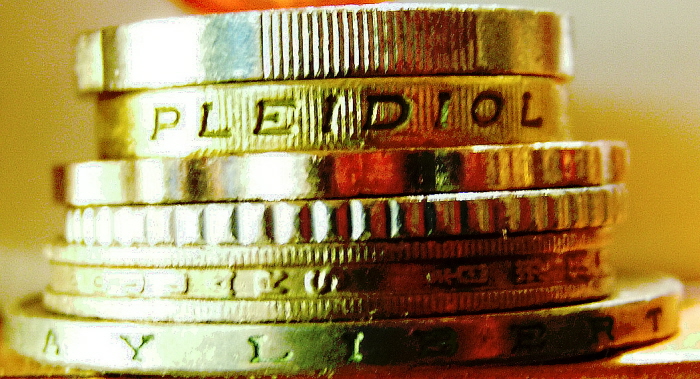
Coin clipping is why many coins have the rim of the coin marked with milled stripes or reeding, engraved text or some other pattern that would be destroyed if the coin were clipped. This practice is attributed to Isaac Newton, who was appointed Master of the Mint in 1699.

The sources I found on the topic of chiseling referenced 8-real silver coins. I imagine clipping happened with many early coins with uneven edges. Like this Spanish gold doubloon.


A silver 8-Reales (Peso) coin minted in México (1621-65). Credit: Centpacrr